Signed in as:
filler@godaddy.com

I worked on Wiley’s brand transformation as the business was adapting to a market being reshaped by AI. The challenge was to make the brand feel more modern, digital and AI-ready, without losing the trust and authority built over two centuries. The wider project covered visual identity, website and employer brand; my role focused on brand and tone of voice guidelines, launch readiness and practical marketing templates that helped teams apply the new brand consistently.
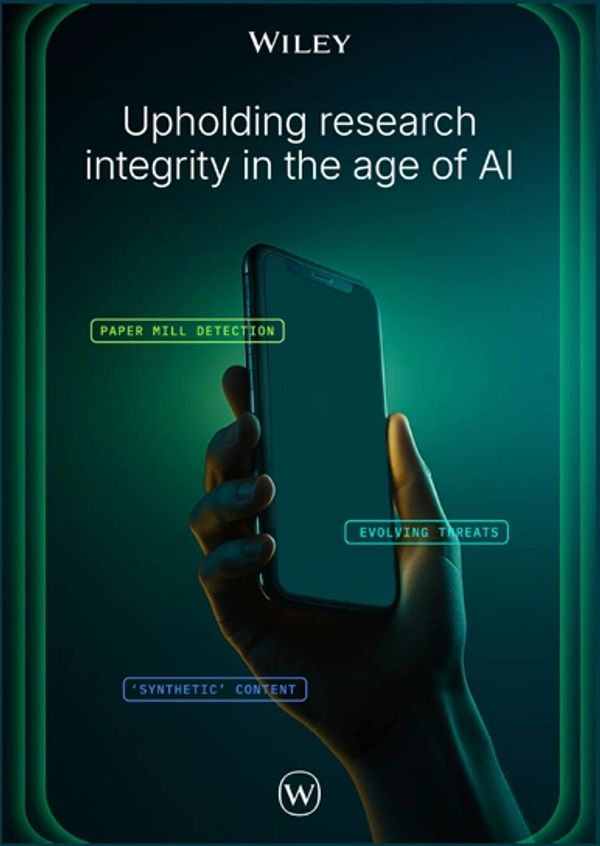
Wiley is a 200-year-old publishing business and a global leader in a market being transformed at pace by AI.
The wider challenge for the brand was to help the business move from being seen as a traditional research and academic publisher to becoming an active knowledge business.
AI could easily have been seen as a threat to publishing. Wiley saw a more interesting opportunity: that high-quality content, data, platforms and trusted publishing relationships become more valuable in a world of LLMs, SLMs and AI-enabled tools, where reliable source material is everything.
The new brand platform centred on ‘From knowledge to impact’, positioning Wiley as a business that transforms knowledge into the intelligence that powers progress.
My role was to lead the brand launch and help turn the new brand into a working system. It needed to be clear enough for launch, practical enough for marketing teams, and flexible enough for a large organisation with lots of different audiences and use cases.
That meant helping shape the brand guidelines, tone of voice principles and practical marketing tools and templates that teams could actually use. A strategy can be strong and a visual identity can be beautifully crafted, but if people cannot apply the brand clearly and consistently a rebrand can fail quickly.
Wiley works across research, learning, publishing, data, platforms and AI, so the language can easily become abstract. Words like impact, progress, knowledge, intelligence and innovation are useful, but only if they stay grounded in what Wiley helps people do.
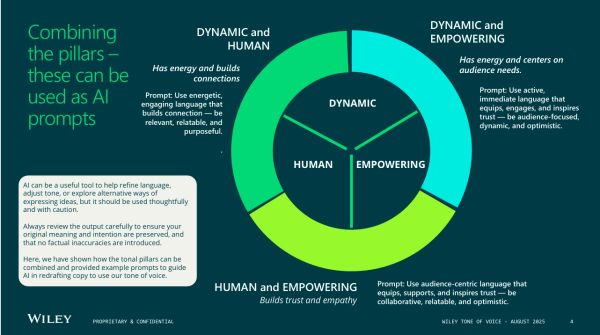
I shaped a tone of voice for the corporate brand around three practical pillars:
That combination did a lot of useful work. Dynamic moved Wiley away from static institutional language and towards a stronger sense of progress.
Empowering kept the focus on the audience. The point was not to tell the world that Wiley had impressive platforms, data or AI-enabled services. It was to explain what those things help researchers, learners, educators, societies and partners achieve.
Human was essential because AI can make brands sound colder, not clearer. Wiley’s work may involve data, publishing systems and AI-powered tools, but the value still sits with people: researchers trying to publish, instructors trying to teach, students trying to learn and professionals trying to make better decisions.
This was the first tone of voice I shaped with AI drafting tools explicitly in mind. I developed practical guidance on how to use AI prompts to write marketing and corporate brand content in the new brand voice, including how to write, what to avoid, how to redraft, and how to use AI without losing accuracy, intention or meaning.
There was no value in pretending AI was not already part of the writing process. The useful position was to show how it could support better drafting, while making clear that human judgement still had to protect the brand.
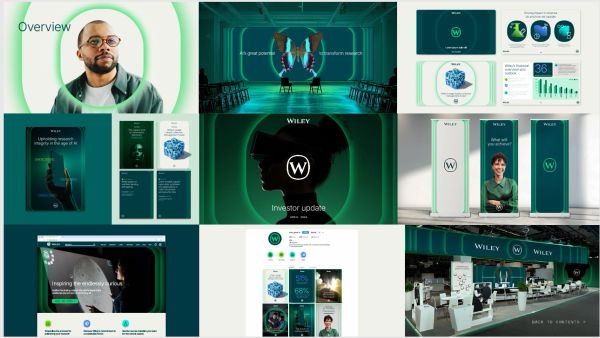
A rebrand succeeds when people across the business can use it properly: in a presentation, a campaign, a social post, a marketing email or a sales asset.
I helped get the brand ready for launch by developing practical templates for PowerPoint, social media and marketing emails, including Canva-based marketing asset templates that teams could use without needing specialist design support every time.
In a large organisation, this is where brand systems either hold or fall apart. Without strong templates, people either drift off-brand or become dependent on central teams for every piece of communication. Neither is sustainable.
The templates helped translate the new brand into everyday formats, making it easier for teams to create consistent, credible and professional communications without slowing everything down.